
Race performance and recovery
A physician-led program that prepares your body to fight for pole position and the podium, then rebuilds it after the checkered flag.
The truck is prepared for months. So is the driver.
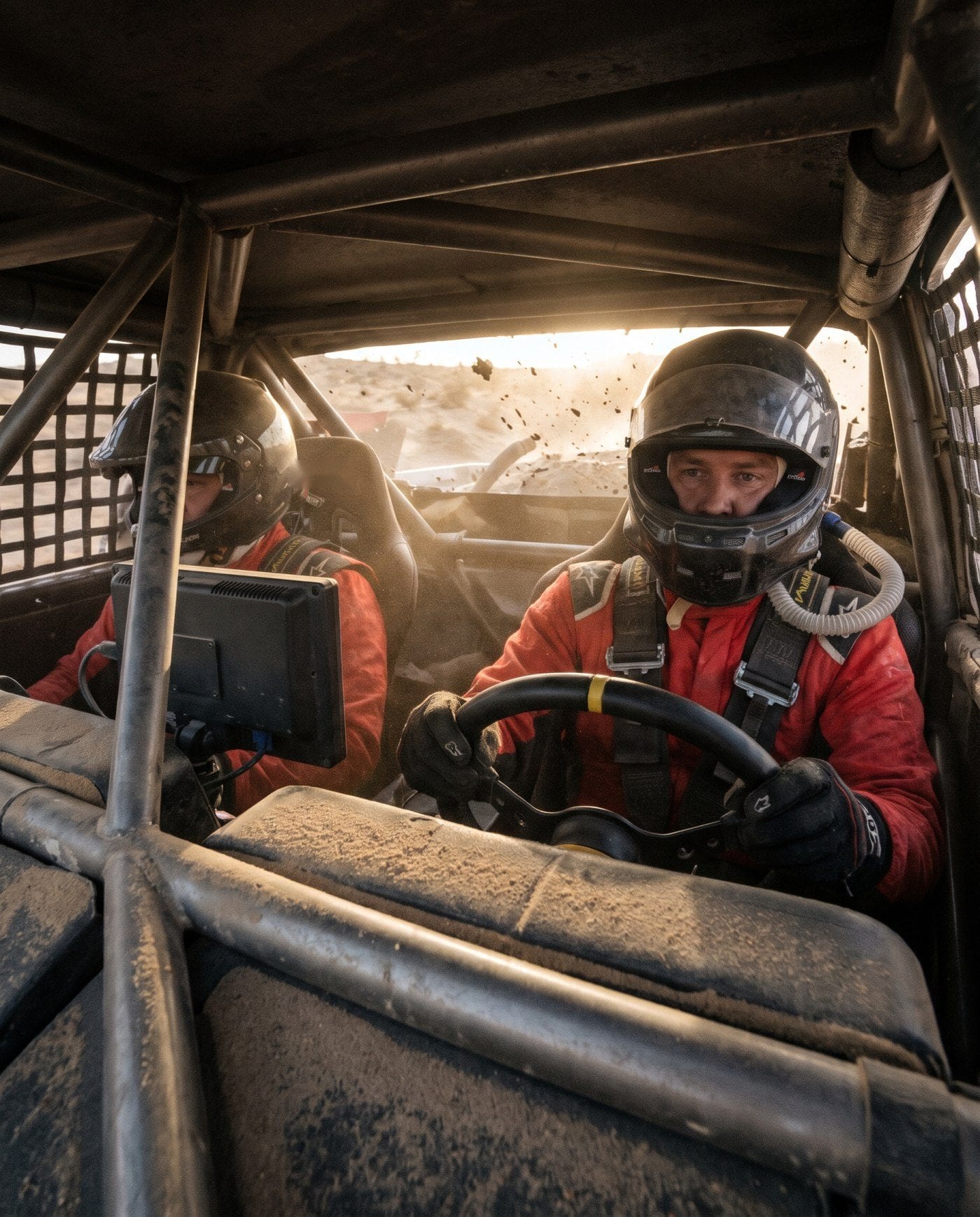
Desert endurance racing means hours at race pace over terrain that never stops hitting back. Heat, impacts and hours of total concentration decide the result as much as horsepower. Measurements taken inside real race cars show what the body is doing while the driver looks still: a heart working near its limit, a rising core temperature and no chance to rest.
What a race does that a simulator does not
Line chart comparing a real race with a simulator at similar heat. In the real race heart rate rises from 125 to 159 bpm, core temperature from 37.6 to 38.5 °C, breathing rate from 28.8 to 34.8 breaths per minute and physiological strain from 3.1 to 7.3. In the simulator heart rate stays at 112 bpm, core temperature goes from 37.5 to 37.4 °C, breathing from 24.0 to 21.7 and strain from 1.1 to 0.7.
Heart rate (bpm)
- 85%of maximum heart rate held late in the stint
- 101 °F(38.5 °C) core body temperature
- 106 °F(41 °C) average cockpit temperature
Hours in the seat
Finishing times at the 2023 SCORE Baja 1000 (1,310-mile course).
Horizontal bar chart of 2023 SCORE Baja 1000 finishing times against the 45-hour official limit: Trophy Truck overall winner 22 h 35 m, Pro UTV Open winner 29 h 25 m, Baja Challenge winner 36 h 40 m, Stock mid-size winner 40 h 37 m, Stock full-size winner 41 h 44 m and Pro Quad Ironman winner 48 h 26 m.
Even the fastest truck spends almost a full day at race pace.
When focus starts to slip
2.0% of your body mass is 3.6 lb (1.6 kg) of fluid.
Attention, coordination and complex problem solving decline, with larger losses doing more damage. Simple reaction time is affected least.
Three systems, one race plan
Tissue repair
Two repair agents applied together: one works at the site of strain and the other across the whole body.
Before the race- Supports tendons, ligaments and muscle under training load.
- Helps settle lingering strains before race week.
Metabolic endurance
Acts on the cell's energy sensor, the same pathway endurance training switches on.
Before the race- Supports how muscle uses fuel during long efforts.
- Complements conditioning and heat training.
Cellular energy
Replenishes a molecule every cell uses to turn nutrients into energy.
Before the race- Supports energy reserves going into race week.
- Supports mental clarity and sleep quality.
The plan around the medication
- Heat acclimation and a hydration strategy
- Sleep plan for race week and night stages
- Neck, core and grip conditioning guidance
- Lab markers reviewed before and after the race
The components of this protocol are supported mainly by laboratory and early clinical research; studies in racing drivers are limited. The protocol supports preparation and recovery and does not replace training, hydration or rest. Individual results vary.
Before the green flag. After the checkered flag.
Baseline assessment
History, past injuries, lab work, body composition, sleep and training load. Eligibility and dosing are defined here.


We prepare you to chase pole position and the podium. Then we help you recover from the win.
Recovery is part of the result
Built for
- Drivers and co-drivers
- Racers carrying old strains into a new season
- Teams that want physician-led preparation
Not for
- Acute injuries that need urgent care or surgery
- Anyone whose medical history rules it out
- Replacing training, hydration or sleep


Take the full protocol with you
Download the 5-page PDF with the timeline and what is included.